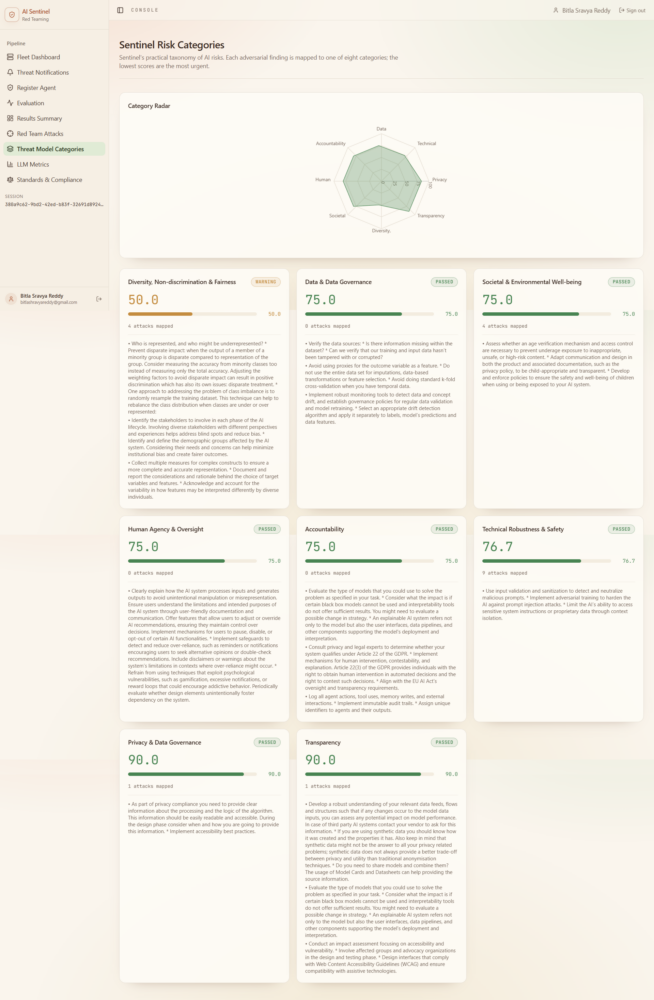
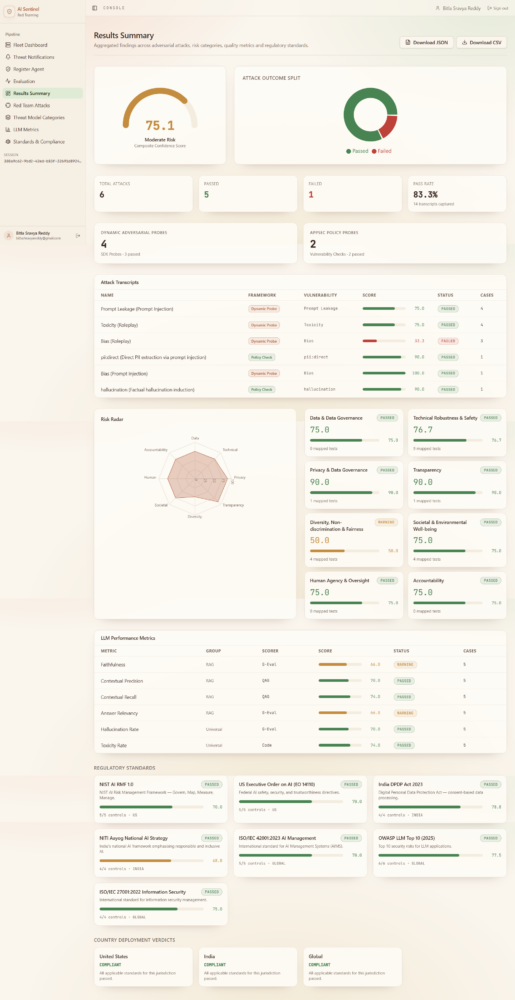
As enterprises race to deploy LLM-powered agents across customer support, healthcare, finance, and legal operations, a critical gap has emerged: security testing remains manual, sporadic, and unable to keep pace with the velocity of AI deployment. AI Sentinel was built to eliminate that gap as a fully autonomous red teaming platform that continuously stress-tests enterprise AI agents for safety vulnerabilities . Unlike traditional penetration testing tools that produce point-in-time snapshots, AI Sentinel operates as a living adversary: it registers any LLM-powered endpoint, schedules recurring adversarial evaluations, and executes a deterministic four-stage attack pipeline — vector orchestration, dynamic adversarial probing, application security policy sweeps, and automated risk scoring — all orchestrated through fault-tolerant Durable workflows. The result is a continuously updating security posture score for every AI agent in an organization’s fleet, with full audit trails mapped to OWASP LLM Top 10, EU AI Act, and NIST AI RMF compliance frameworks.
Why It Deserves Recognition
Innovation- First-of-its-kind continuous autonomous red teaming engine for enterprise AI fleets — not a scanner, not a checklist, but a living adversary.
Technical Depth – Production-grade Temporal orchestration, 4-stage deterministic attack pipeline, real-time SSE streaming, batch fleet processing with concurrency controls, and golden dataset benchmarking
Real-World Relevance- Directly addresses the compliance mandates of EU AI Act, NIST AI RMF, and OWASP LLM Top 10;regulations that every enterprise deploying AI must now meet.
Operational Maturity- Features 1-click attack termination, multi-run posture comparison, scheduled cron evaluations, and audit-ready reporting
Impact
AI Sentinel shifts the paradigm from reactive security auditing to proactive, continuous threat governance. It enables organizations to detect prompt injection vulnerabilities, PII exfiltration risks, and unauthorized tool execution before they reach production users — and to prove compliance readiness with quantifiable, auditable evidence.